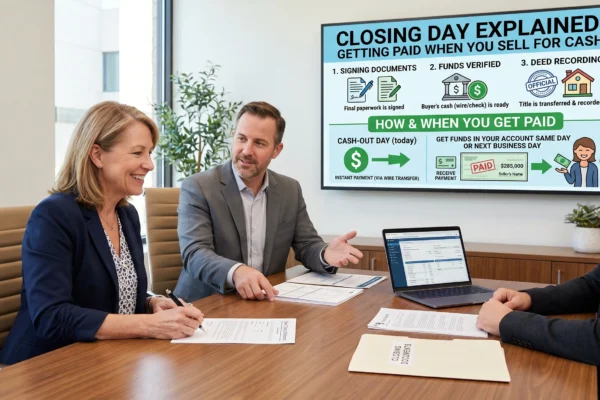

Many sellers hear “cash” but you should know it often means a buyer pays without a mortgage or uses quick funding; expect faster closings, the risk of low offers or scams, and the need for clear title and proof of funds.
Key Takeaways:
- “Cash” means no traditional mortgage; buyers pay with liquid funds, private investor capital, or short-term loans that act like cash, and sellers typically require a proof-of-funds statement before accepting an offer.
- Cash offers usually close faster because there is no lender underwriting, and buyers often waive financing and appraisal contingencies to speed the process.
- Title and escrow companies handle closings: they perform title searches, coordinate payoffs of liens, collect closing costs, and record the deed once funds are received and documents are signed.
- Closing mechanics involve signing settlement statements and deed transfers, wiring or delivering funds to escrow, and recording the transaction; inspections and negotiated repairs remain common even with cash deals.
- Risks include lower sale prices for sellers, potential buyer fraud or fake proof-of-funds, and wire-transfer scams; verify all funds and use a reputable title/escrow agent or attorney for protection.
Defining “Cash” in Real Estate Transactions
Cash often means the buyer isn’t depending on a mortgage at closing; you should expect immediate purchase funds or verifiable liquid assets rather than a loan commitment. This distinction affects timelines, documentation, and your closing risks.
When sellers hear “we buy houses in cash,” many buyers use private capital, hard-money, or pre-approved lines that act like cash but can carry funding fall-through risk if not properly documented for you.
Liquid Funds vs. Traditional Mortgage Financing
Liquid funds are wire-ready bank balances or verified investor capital that let you close faster and avoid lender contingencies, offering the benefit of quicker closings you can rely on.
Mortgage financing brings appraisal, underwriting, and loan conditions that can delay closings and introduce contingency risks you must factor into accepting an offer.
The Role of Private Equity and Institutional Capital
Private buyers often use personal or group capital; you may see straightforward closings but also lower offers if buyers require quick returns, so confirm proof of funds.
Institutional capital pools investor money and can close through prearranged facilities, yet you should watch for assignment chains or sale-leaseback structures that alter original terms affecting you.
You must demand clear proof of funds and transparent assignment disclosures when dealing with private equity or institutions, because undisclosed assignment clauses and rushed timelines can expose you to legal or financial risk.
The Proof of Funds: Verifying Buyer Liquidity
Banks and title companies will request documentation so you can confirm the buyer has liquid funds or an available lender commitment before signing. Expect verification to include bank letters, recent statements, or a verified proof-of-funds (POF) letter sent directly to your escrow agent.
Proof of funds speeds closings and protects you from wasted time and liability if the buyer can’t pay. Title or escrow agents typically verify the source, and a missing or weak POF can be grounds to pause the transaction to avoid a failed closing.
Essential Documentation for Financial Verification
Bring bank statements, a POF letter on bank letterhead, and any lender commitment if financing is involved so you can see immediate availability. Wire-ready instructions and cashier’s-check details also help the title company confirm funds will be delivered on closing day.
Common red flags include stale or doctored statements, accounts with insufficient balances, and hidden liens. Ask the escrow officer to verify directly with the issuing bank to avoid accepting fraudulent documents.
Distinguishing Direct Buyers from Intermediaries
Verify whether the buyer will fund the purchase directly or is acting as an intermediary by requesting bank verification in the buyer’s or buyer-entity’s name; intermediaries often use assignment contracts or wholesale agreements that transfer your contract for an assignment fee.
Direct buyers typically provide title company wiring details and close more quickly, while intermediaries may require back-to-back or double closings. Have the title company confirm the funding source to protect you from payment gaps.
Watch for contracts that let an intermediary assign without escrow protections; insist that funds be held by the title company and that the closing statement names the final payer so you don’t end up unpaid.
Why Cash Offers Streamline the Sale
Cash offers cut lender timelines and eliminate underwriting waits, so you can often close in days instead of weeks; you get faster certainty and less scheduling hassle.
Fewer stakeholders and no financing contingencies mean you face fewer ways a deal can fall apart, letting you lock a firm closing date and move forward with confidence.
Eliminating Appraisal and Financing Contingencies
Appraisal contingencies disappear with cash, so you avoid appraisal-related delays and renegotiations that lenders often trigger; you reduce the chance of a canceled sale.
What you give up is the lender’s valuation safeguard, so you should assess the risk of overpricing or undisclosed defects before accepting a cash buyer’s offer.
Bypassing Lender-Mandated Property Inspections
Skipping lender-mandated inspections speeds closing because you remove the lender’s inspection timeline, but you may accept the property as-is and inherit unseen repair liabilities.
You should still hire a private inspector if condition matters, since hidden defects remain your responsibility in many cash transactions. Even on buying ugly houses.
Consider that many cash buyers-especially investors-waive inspections to close fast; waiving inspections speeds the process but raises your exposure, so verify insurance, disclosures, and escrow protections before finalizing.
The Mechanics of a Cash Closing
Closing a cash sale typically compresses tasks you’d see in financed deals: you sign transfer documents, the seller delivers a deed, and escrow coordinates the payment. Expect a faster timeline-often same-day to a few days-because there’s no lender underwriting delaying the process.
Cash transactions still require steps you must complete: present ID, show proof of funds, and confirm the final settlement statement. Title defects or escrow holds can pause closing, so ask the title company for a clear checklist of any outstanding encumbrances.
Title Search and Clearing Property Encumbrances
Title searches uncover liens, unpaid taxes, and judgments that can block transfer, and you’ll rely on the title company to produce a preliminary report. Review that report so you know which items require payoffs or releases; insist on title insurance if you want protection against hidden defects.
Escrow Procedures and Final Wire Transfer Protocols
Escrow holds documents and funds until all closing conditions are met, prepares the closing statement, and records the deed once you and the seller have signed. You should verify that escrow will only disburse funds after title clearance and recording to avoid premature releases.
Wire instructions require strict verification: always call the title company at a phone number you already have to confirm account details, and never follow unverified emailed instructions. Wire fraud is common; confirm recipient name, routing number, and last four digits before sending funds, or ask about using a cashier’s check if you’re unsure.
Financial Analysis: Net Proceeds and Savings
Calculating your net proceeds means subtracting mortgage payoffs, liens, taxes, repairs, and all closing costs from the cash offer so you know the actual amount you’ll walk away with.
Conservatively estimate unexpected fees and prorations so you don’t overstate the benefit; a headline “cash” price can hide hundreds to thousands in deductions that reduce your final check.
Reducing Closing Costs and Commission Fees
Negotiating directly with a cash buyer can reduce or eliminate the typical agent commission, which can increase your take-home cash by several percent of the sale price.
Avoid surprise title, escrow, or processing fees by requesting an itemized closing estimate and agreeing in writing who will pay each line item before you sign.
Evaluating Sale Speed vs. Maximum Market Value
Deciding between a rapid cash sale and listing for top market price depends on how much discount you’ll accept versus the carrying costs and time you’ll avoid; fast offers often include a price haircut.
Faster closings eliminate ongoing mortgage, insurance, and repair obligations, which can justify a lower offer when you face deadlines, pending foreclosure, or relocation.
Compare your monthly carrying costs to the percentage discount on the cash offer; if the saved months multiplied by your monthly cost exceed the discount, the quick sale can yield a higher net result.
Due Diligence When Selecting a Cash Buyer
When you evaluate offers, insist on seeing proof of funds and a clear closing timeline so you avoid buyers who promise fast cash but stall. Verify the escrow and title partners they name to reduce the chance of last-minute issues.
Check for patterns in their dealings: repeat short closing windows, frequent buyer assignments, or sudden price changes can signal risk. Insist on written terms to protect yourself against hidden fees and unexpected delays.
Assessing Professional Reputation and Transaction History
Ask for references from recent sellers and contact them about actual closing times and any post-closing disputes; reliable buyers will provide verifiable names. Review sample purchase contracts to see standard clauses they use.
Look up complaints with the Better Business Bureau and county court records for lawsuits or liens tied to the buyer; legal claims or repeated defaults are major red flags that you should avoid.
Understanding Contract Terms and “As-Is” Clauses
Read the “as-is” clause carefully: it commonly means you will not get repair requests honored, but it does not remove the buyer’s obligation to deliver clear title. Ask whether title defects are covered or excused.
Confirm who pays closing costs, escrow fees, and whether the contract allows assignment to another entity; assignment clauses can transfer your buyer to a less reputable party without your consent.
Ensure the contract specifies a firm closing date, an explicit title contingency, and an earnest money refund term if the buyer fails to close; have your attorney review vague language to protect your proceeds.
Final Words
From above you should treat “cash” offers as funds ready at closing, often from private investors or company reserves rather than your buyer’s personal bank account. You will see proof of funds, quick title searches, and an escrow or closing agent handle paperwork; funds are wired to escrow and released after title and liens clear. You can expect faster closings but confirm fees, closing costs, and written timelines before you sign.